
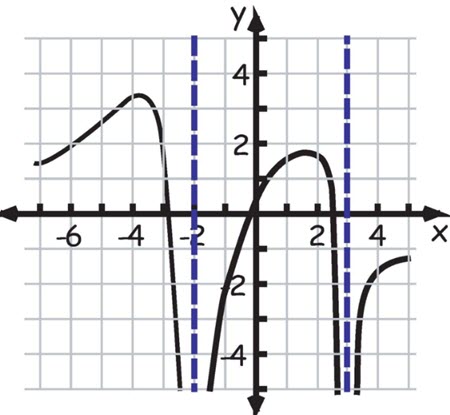

Solutions of the cubic Function
We have already discussed most of it in our polynomials discussion.
The following discussion takes care of all possible values of the solution when we are facing a problem involving the cubic function.
Given:

Let’s depress the equation.

We apply the substitution




We simplify:

We factor like terms and eliminate cancelling terms:


Dividing by  we can let:

and

We get the deprecated function.

Please note that when  , we can simply deduct the 3 values of
  from those of
  .
.
This situation is ideal because the term in  has vanished.
Let:

We get



We can see that :
 and
and  will make our equation
  .
.
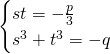
Let’s cube the first line:
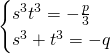
Now let:
 and
and 
We get:

To solve this we’ll use:

If  , the equation has one real root and 2 complex roots
If  , the equation has one root
  and a double root
If  , the equation has three real roots
Case 

We have complex roots:


 with
with 
If 
We get:
![z=\sqrt[3]{-p}e^{\frac{2k\pi}{3}i}](https://www.mouctar.org/wp-content/ql-cache/quicklatex.com-7364220dbbbae84adfa94c9d85637503_l3.png "Rendered by QuickLaTeX.com")
![x_1=\sqrt[3]{-p}-\frac{b}{3a}](https://www.mouctar.org/wp-content/ql-cache/quicklatex.com-f890c24a37441241448a4335190f0bca_l3.png "Rendered by QuickLaTeX.com")
![x_2=\sqrt[3]{-p}\cos (\frac{2\pi}{3})-\frac{b}{3a}+\sqrt[3]{-p}\sin(\frac{2\pi}{3})i](https://www.mouctar.org/wp-content/ql-cache/quicklatex.com-a42d3046ca26ec9ca366dc6187688e6b_l3.png "Rendered by QuickLaTeX.com")
![x_3=\sqrt[3]{-p}\cos (\frac{4\pi}{3})-\frac{b}{3a}+\sqrt[3]{-p}\sin(\frac{4\pi}{3})i](https://www.mouctar.org/wp-content/ql-cache/quicklatex.com-b9df243cfbc0d322aee26e80f08b7c4f_l3.png "Rendered by QuickLaTeX.com")
Case



if 




if 




Case

This means:
 Meaning
We get the following solutions:
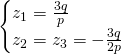
We use
to get
Case
We proceed as follows:
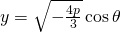
When we replace in our equation:




By simple division we get:

Let’s simplify the left side:

From this we get:

If we let :

From our main equation:

Replacing from above


The same technic we used earlier helps us get
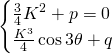
With
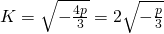
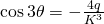
The simplified Equation is:
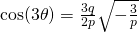 Remember
 with
with
Our Solutions:
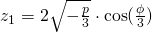


We can now find .



Case
when
Here we say:
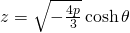
The same transformations yield:

And:

when
Here we say:
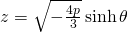
The same transformations yield:

And:

General rule for all solutions including the complex conjugates:
From
With:
First case: when
Let’s calculate  and
and 
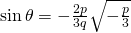
Now:
![\tan \phi=\sqrt[3]{\tan (\frac{\theta}{2})}](https://www.mouctar.org/wp-content/ql-cache/quicklatex.com-b9dd26e232904cc8dd1a79117751741f_l3.png "Rendered by QuickLaTeX.com")
The values:
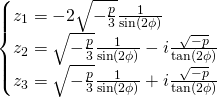
For values we just apply
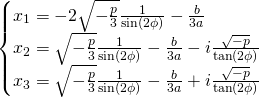
Second case: when
Let’s calculate and
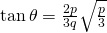
Now:
The values:
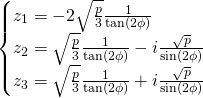
For values we just apply
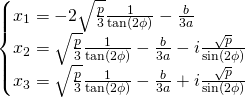
Example 1:
Find the solutions of the following equation:

Solution:

Instead of using multiple tries between 72 and 10 and their factors, we are going to use the methods learned here.
To avoid big numbers, let’s divide the function by 10.
We get

We have the following coefficients:


Let’s calculate  and
and 





Both values were left at their fractions forms to avoid accuracy loss.
Now:


We are in the case where
We call our method to get the 3 real roots:

 in degrees



The solutions:






Finally the solutions are:
Answer:  ,
,  and
and 
Example 2:
Find the solutions of the following equation:

Solution:

Instead of using multiple tries between 4 and 50 and their factors, we are going to use the methods learned here.
To avoid big numbers, let’s divide the function by 50.
In future exercises, we’ll use simplest methods.
We get:

We have the following coefficients:


Let’s calculate and

We plug in:


The exponent  vanishes


Here:


Let’s check on 


We are in the case where
We get the following solutions:
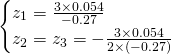
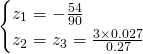
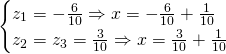
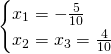
Finally the solutions are:
Answer:  ,
,  and
and 
Example 3:
Find the solutions of the following equation:

Solution:

Instead of using multiple tries between 6 and 1 and their factors, we are going to use the methods learned here.
In future exercises, we’ll use simplest methods.
We have the following coefficients:


Let’s calculate and

We plug in:









If , the equation has one real root and 2 complex roots
Let’s calculate and


Now:
![\tan \phi=\sqrt[3]{\tan(\frac{27.95134905}{2})}](https://www.mouctar.org/wp-content/ql-cache/quicklatex.com-4c493943b366fd97c5a2aec5ccec5c18_l3.png "Rendered by QuickLaTeX.com")

The values:
For the values:
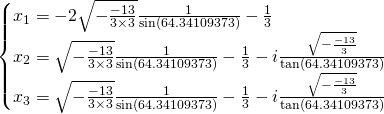
We get:

Finally the solutions are:
Answer:  ,
,  and
and 
Atlernate methods using division
The following documents show how the division can get the factors, reducing the cubic function to a product that we normally solve:
Example 1:
Find the solutions of the following equation:
Solution:
[accordion hideSpeed=”300″ showSpeed=”400″][accordion hideSpeed=”300″ showSpeed=”400″]
[item title=”Click here to see the solution of: “]
{aridoc engine=”pdfjs” width=”100%” height=”800″}images/Alternate2.pdf{/aridoc}
[/item] [/accordion]
Example 2:
Find the solutions of the following equation:
Solution:
[accordion hideSpeed=”300″ showSpeed=”400″][accordion hideSpeed=”300″ showSpeed=”400″]
[item title=”Click here to see the solution of:“]
{aridoc engine=”pdfjs” width=”100%” height=”800″}images/Alternate1.pdf{/aridoc}
[/item] [/accordion]
Example 3:
Find the solutions of the following equation:
Solution:
[accordion hideSpeed=”300″ showSpeed=”400″][accordion hideSpeed=”300″ showSpeed=”400″]
[item title=”Click here to see the solution of:“]
{aridoc engine=”pdfjs” width=”100%” height=”800″}images/Alternate3.pdf{/aridoc}
[/item] [/accordion]
HELPER FUNCTION
Open this using the right box with pointing arrow and select ‘OPEN WITH GOOGLE SHEETS’ to solve more cubic equations.
{aridoc engine=”google” width=”100%” height=”800″}images/cubic1.xlsx{/aridoc}

Be the first to comment