

Indefinite Integral
We have covered the introduction to derivatives. Another topic would be to find a function if we know it’s derivative.
This very interesting and we won’t spend much time explaining what the antiderivative is in that case.
A function  is an antiderivative of the function
  if
if  for all
  in the domain of .
The only problem is when we calculated the derivative of a constant  , we found
  .
.
Let’s check the following fact:
If we have 
We know that 
But so is:  .
.
And we can add any constant, the derivative will be the same.
We get the theorem:
Theorem: General form of antiderivatives
Let be an antiderivative of over an interval  . Then,
1. For each constant , the function  is also an antiderivative of over .
2. If  is an antiderivative of over , there is a constant for which
  over .
Meaning, the general form of the antiderivative of over is .
EXAMPLE:
Find the antiderative of 
We can see that it is 
Indefinite Integrals
This is the notation used for the antiderivatives.
![\[\int f(x) dx=F(x)+C\]](https://www.mouctar.org/wp-content/ql-cache/quicklatex.com-07bfc70862149e1ed00a28339b2d469b_l3.png "Rendered by QuickLaTeX.com")
 is called the
  and the variable is the
Fundamental formulas
![1. {\displaystyle \int \frac{d}{dx}[f(x)] \,dx}=f(x)+C](https://www.mouctar.org/wp-content/ql-cache/quicklatex.com-57080cd953bd542f6e92f38d4010d7af_l3.png "Rendered by QuickLaTeX.com")
![2. {\displaystyle \int [f(x)+g(x)] \,dx}=\int f(x) dx+ \int g(x) dx](https://www.mouctar.org/wp-content/ql-cache/quicklatex.com-abf495386b7103fc653f925fa01d374c_l3.png "Rendered by QuickLaTeX.com")
 with
with  a constant
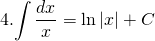
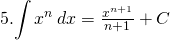
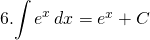
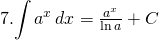 with
with  ,
, 

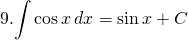











Problem 1:
Solve: 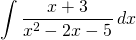
We know that 
From  we can do some inspection

We get
(1) 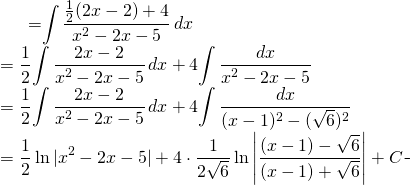
Finally:

Problem 2:
Solve: 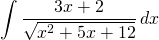
We know that 
From  we can do some inspection

We get
(2) 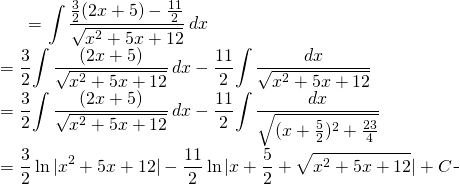
Finally:


Be the first to comment