
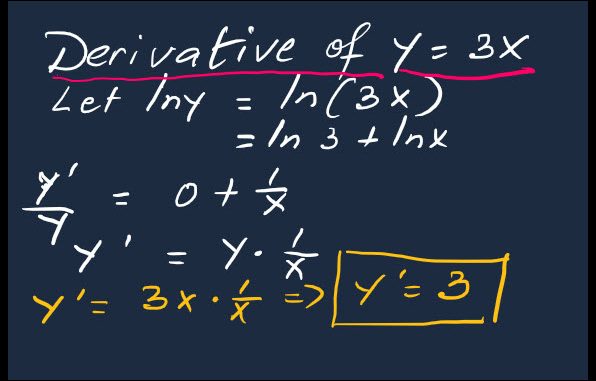

Derivatives
After a brief coverage of the  calculations, we can now start diving into the heart of the differentiation calculations.
In geometry, when we calculate the slope of the tangent of given graph, we get the rate of change at the tangency point.
We are going to use that information and define our derivatives.
Let’s take a point on a function : 
If  is the value of
  at the tangency point, we can write the value of the slope
  as follows :
![\[m=\lim_{h \to 0}\frac{f(a+h)-f(a)}{h}\]](https://www.mouctar.org/wp-content/ql-cache/quicklatex.com-eae579a063931b27c17f57a50ee3f5e0_l3.png "Rendered by QuickLaTeX.com")
.
We’ll use to define the derivative:
The  of a function
  noted
noted  can be written:
![\[f'(x)=\lim_{h \to 0}\frac{f(x+h)-f(x)}{h}\]](https://www.mouctar.org/wp-content/ql-cache/quicklatex.com-3c331460d426976fdca36f6a528b0f50_l3.png "Rendered by QuickLaTeX.com")
as long as the limit exists.
We may also use the following notation:
![\[\frac{dy}{dx}=f'(x)\]](https://www.mouctar.org/wp-content/ql-cache/quicklatex.com-04d92fc292d794e84d7f31129f007346_l3.png "Rendered by QuickLaTeX.com")
If we let 
And we add a change to the value of , changing it to  , we will cause
  to change to
This means:

Pairing the following equations and subtracting:
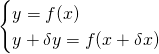
We get :

If we divide by  and making very close to
We have the corresponding differential of 
![\[\frac{dy}{dx}=\lim_{\delta x \to 0}\frac{\delta y}{\delta x}=\lim_{\delta x \to 0}\frac{f(x+\delta x)-f(x)}{\delta x}\]](https://www.mouctar.org/wp-content/ql-cache/quicklatex.com-af461e245835d99414c5abb8b4384302_l3.png "Rendered by QuickLaTeX.com")
This is the derivative of the function.
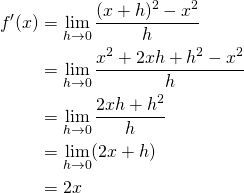
EXAMPLE
Differentiate 
(1) 
Problem:
Given

Find:

Solution:

(2) 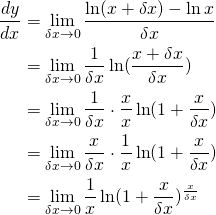
But we know that:
For values of  when
when  ,
, 
Combining with the definition of  in our logarithms definition:

Finally:

We write:
![\[(\ln x)'=\frac{1}{x}\]](https://www.mouctar.org/wp-content/ql-cache/quicklatex.com-f3b7d4ced963ca43ba3d25da365d413a_l3.png "Rendered by QuickLaTeX.com")
Table of fundamental derivatives
| No. | Function | Derivative |
 |
 |
|
 |
|
 |
 |
 |
|
 |
 |
 |
 |
 |
 |
 |
 |
 |
 |
 |
 |
 |
![\sqrt[n]{x}](https://www.mouctar.org/wp-content/ql-cache/quicklatex.com-89c170a91e97692d1b9a5dc1ae6711b2_l3.png "Rendered by QuickLaTeX.com") |
![\frac{1}{n\sqrt[n]{x-1}}](https://www.mouctar.org/wp-content/ql-cache/quicklatex.com-72435407e9c92fac67d515ebf49c886b_l3.png "Rendered by QuickLaTeX.com") |
 |
 |
|
 |
 |
 |
 |
 |
 |
 |
 |
|
 |
 |
 |
 |
 |
 |
 |
 |
 |
 |
 |
 |
 |
 |
 |
 |
 |
 |
 |
 |
 |
 |
 |
 |
 |
 |
 |
 |
|
 |
 |
 |
 or or  |
 |
 |
 or or  |
 |
 |
 |
 |
 |
 |
 |
 |
 |
 |
 |
 |
 |
 |
 |
 |
 |
 |
 |
 |
 |
 |
 |
 |
 |
 |
 |
 |
|
|
 |
 |
 |
 |
 |
 |
 |
 |
 |
 |
 |
 |
 |
 |
 |
 |
 |
 |
 |
 |
 |
 |
 |
 |
 |
 |
 |
 |
 |
 |
 |
 |
 |
 |
 |
 |
 |
 |
 |
 |
 |
 |
 |
 |
 |
 |
 |
 |
 |
 |
 |
 |
 |
 |

Be the first to comment