
Exponential Growth and Decay
The law of Uninhibited Growth can be termed as follows:
With  the initial amount at the beginning ( time t=0) and the constant

This function can be a growth or a decay depending on the value of 
If  this is an exponential law or the Law of Uninhibited Growth.
If  it is the Decay.
For a Growth of cells, we will have
It is usually noted:

Radioactive Decay:
It is the same formula but with
For the carbon dating, we refer to the half-life. This is about  for the carbon 14.
While the carbon 12 won’t change, it helps to find the time when a given organism died, when compared to the amount of carbon 14.
Example:
The amount of carbon 14 found in a carbon 14 dating process is 2.15% of the initial amount.
Using the half-life of carbon 14 as 5600 years, when did the organism die?
Solution
For  the value is half of the original:






The equation is now:

In this situation, 




 years ago.
Newton’s law of cooling:
The  temperature of a heated object at a given time
  , with ,
  the original temperature and
  the temperature of the surrounding medium.

Logistic models use the following formula:
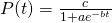
Constants  and
and  are
are  . if
. if  we have a Growth. If
  it is a decay.
is called the 

Be the first to comment