
Solve for 

We take the exponent 125 of both sides:

This is simply:


Answer:
Solve for

We have:


Answer:
Solve for





Solve for

We can write:


Answer:
Evaluate:

We can write:


Answer:
Solve for


Answer:
Solve for

We write:


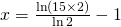


Answer: 
Solve for and round to the nearest hundred

We have:



Answer:
Solve for

We can write:


This simplifies to:


Answer:
Solve for

We can write:


Answer:
Solve for

We can write:










Answer:
Solve for

We have to check on 
The reciprocal is 

Back to the equation:

That means:

Finally:
Answer:
Solve for




Finally

Answer:
Solve for

Let’s say: 
The equation becomes:

Only one root here:  is always


Back to notation:


Finally:
Answer:
Solve for :



We get:


Re-arranging:

Solving we get:
 and
and 
But must be
The solution is :
Solve for

We know that:

But:

Back to the equation:

If we take the exponent on both sides we get:




For factoring, let’s find two numbers having a sum of  and a product of
  .
.
These two numbers are  and
and 
We plug them in:



The two roots are:
This will not work because we will have to take the  -Not possible.
Then
This solution verifies our equation.
Finally:
Answer: .
Solve for


We get:
 , unique case since the second will have no solution.


Find two numbers having a sum of and a product of  . They are
  and .
and .
The equation becomes:



The roots:

This is a valid results that verifies our equation.

The second root:

This root also verifies the equation.
Finally:
The solution is and
Solve for :

Let’s change the variable: 
we have:

Find two numbers having a sum of  and a product of
  . These can be
  and
and 
The equation becomes:



The roots:


For: 
We get:


Second root:


With  ,
,
we get:

We can also write:
![x=\sqrt[3]{e}](https://www.mouctar.org/wp-content/ql-cache/quicklatex.com-ea8b5cc68c3de21507c5fbc5e04e5059_l3.png "Rendered by QuickLaTeX.com")
Solve for :

We can write:


We change variable: 
We get:



Back to



The other value of  is negative and to be rejected.
Answer:
Solve for and 
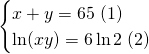
From (2) we have:


We get:

From (1) we have:


In the new (2):
We plug in:



Find two numbers with sum  and product
  . They are
  and .
and .



The roots are:

and 
Finally:
The solution is:
and 
Or:
and 
Solve for and
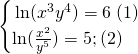
Let’s re-write:
For (1):



For (2):



Our system can now be written:
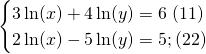
By elimination, We multiply (11) by  and (12) by and add the results up.


When we add:



![y=\frac{1}{\sqrt[23]{e^3}}](https://www.mouctar.org/wp-content/ql-cache/quicklatex.com-a02fcb7886f9ad4d54df6b8c6689d441_l3.png "Rendered by QuickLaTeX.com")
Now we proceed the same way to eliminate 
By elimination, We multiply (11) by  and (12) by
  and add the results up.


When we add:


![x=e^{\frac{50}{23}}=e^{\frac{46}{23}\cdot\frac{4}{23}}=e^{2}\sqrt[23]{e^{4}}](https://www.mouctar.org/wp-content/ql-cache/quicklatex.com-d3ab75f4a31dcc46c262e5060eb3c9e9_l3.png "Rendered by QuickLaTeX.com")
Finally the solution:
![x=e^{2}\sqrt[23]{e^{4}}](https://www.mouctar.org/wp-content/ql-cache/quicklatex.com-2b8e782fbc7430ebf92ee6bb2f92e65f_l3.png "Rendered by QuickLaTeX.com")
These values verify our system of equations.

Be the first to comment