
Solve for 

We can write:



We can also write:

Answer:
Solve for

We can write:




Answer:
Solve for

We can write:


Answer
Solve for
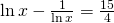
We write:
Let 
The equation becomes:

To common denominator:

Find two numbers of sum  and product
  . These are and
  .
.
We write:



First value:


Second value:


Or:
![x=\frac{1}{\sqrt[4]{e}}](https://www.mouctar.org/wp-content/ql-cache/quicklatex.com-43261196c9ecf7bd6b2636795d60aeee_l3.png "Rendered by QuickLaTeX.com")
Answer: and
Solve for

Let 
We can write:




Three roots for t:
First case:


Second Case:



Third Case:



Answer: , and
Solve for

We can write:

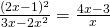
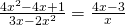


In grouping by coefficients we get:


To factor find 2 numbers with a sum  and a product of
  . These are
  and
and  .
.
We write



First case:

This is not acceptable in original equation.
Second case:

This value verifies the equation when we plug in.
Third case:


When we plug in: Both members value is 
Answer: and
Solve for

We can write:



We use the following table:
| Factor |  |
 |
 |
|
 |
|
 |
 |
|
|
|
 |
|
|
|
We can see the solution:
 and
and 
Answer: and
Solve for

We can write:


Find two numbers with a sum of  and a product
  . These are
  and
and 
We can now re-write:



We use the following table:
| Factor |  |
 |
 |
 |
|
|
|
 |
|
|
|
 |
|
|
|
We can see the solution:
For  , the factor is
However, this will not satisfy  . So that range is to be rejected.
For  , the factor is . This value satisfies our equation
Answer:
Solve for
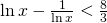
We write:
Let

Common denominator: 


To factor we need two numbers having a sum of  and a product of . These are and .
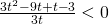
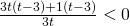
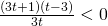
We use the following table:
| Factor |  |
 |
 |
 |
 |
|
|
|
|
 |
|
|
|
|
| 3t | |
|
|
|
 |
|
|
|
|
We can see the solution:
The solution is :
Now back to


Or:
![0<x<\frac{1}{\sqrt[3]{e}}](https://www.mouctar.org/wp-content/ql-cache/quicklatex.com-c55e31c51793eda120e8537c568f1328_l3.png "Rendered by QuickLaTeX.com")
The second case:


Answer: ,
Solve for :

Our first step is to see where we can get a weak link in this equation. The designers always keep one door open.
Let’s check the factors:
(1) 
This is our first catch.
Let’s investigate further:
(2) 
As suggested, we found two polynomials equal to the ones in the equation.
Now we need our logarithms experience:
It says:
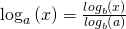
Back to our factors:

But another rule is:

Now we have:

But another log rule is
 . Even if we apply the previous rule we get 1.
That means:

On the other side of the equation:
(3) 
Our final equation:
 (1*)
(1*)
From what we know now we get:

Now let’s introduce another variable: 
Let 
That means: 
From (1*):

Multiplying all by we get:

Let’s factor this:



The solution is  or
or  ;
;
For :

It means:  with a solution of
  . Not acceptable since
  must be
Now for :

It yields:

 After simplification.


 (2x+3) becomes negative. Not acceptable.
Now for  we can easily verify that the solution is good.
Finally:
is our solution.

Be the first to comment