

Hyperbolic functions
We have used some hyperbolic functions relations in some of our chapters.
This is a summary of these functions to enable us to use them in future chapters.
We’ll go through their definitions and we’ll use the similarities with the regular trigonometric functions to see most of the formulas.
 |
Equation |
 |
 |
 |
 |
 |
 |
 |
 |
 |
 |
 |
 |
 |
 |
 |
 |
 |
 |
 |
 |
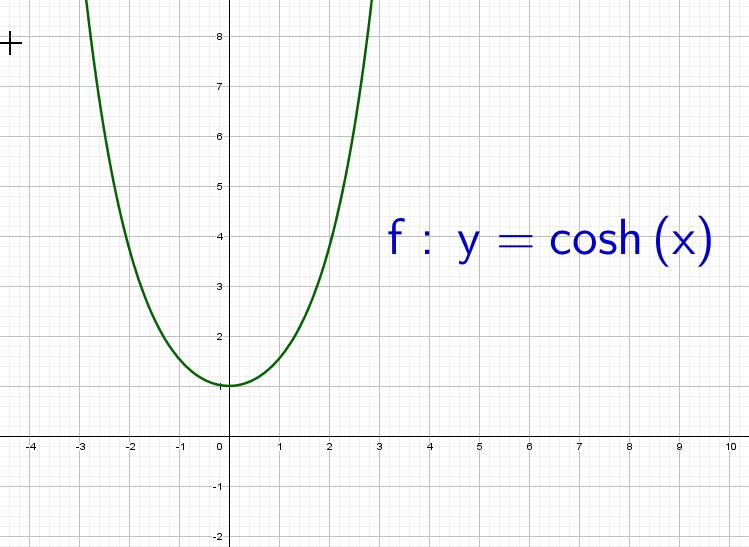
Hyperbolic cosine function
The  noted
noted  is defined as follows:

This straight forward definition will be used to generate other formulas.
Hyperbolic sine function
The  noted
noted  is defined as follows:

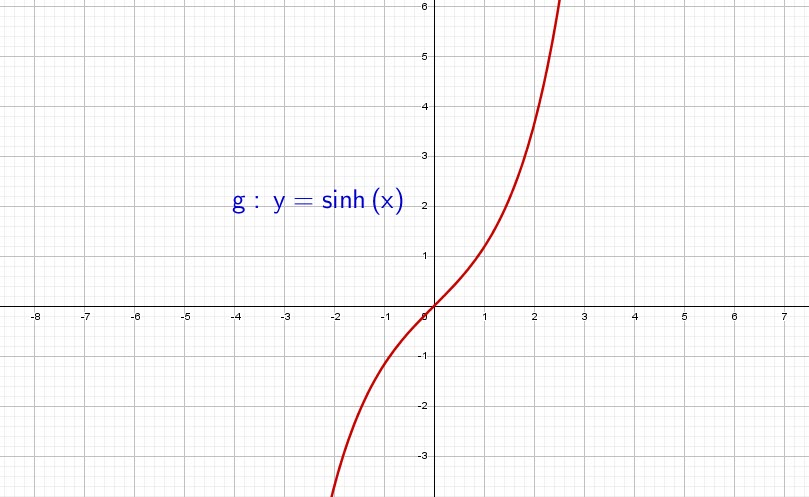
This straight forward definition will be used to generate other formulas.
Other hyperbolic functions
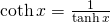
Without any surprise we can write:
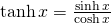
We get
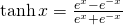
Please note:
When we note:
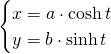
When  changes in the real numbers, the points
  follow one branch of the hyperbola.
Hyperbolic Trigonometry


 This shows that
We can also show that:

Sum and Difference formulas
Using the above relations we can get:




Double angle


For the tangents:



Transformation formulas
From the formulas shown above, we can get:
![\cosh a \cosh b=\frac{1}{2}[\cosh (a+b)+ \cosh (a-b)]](https://www.mouctar.org/wp-content/ql-cache/quicklatex.com-7d9e6b2492c9c34dbd8824ed4ddb4368_l3.png "Rendered by QuickLaTeX.com")
![\sinh a \cosh b=\frac{1}{2}[\sinh (a+b)+ \sinh (a-b)]](https://www.mouctar.org/wp-content/ql-cache/quicklatex.com-87a2a19b2ac3030956c1e54377172ad7_l3.png "Rendered by QuickLaTeX.com")
![\sinh a \sinh b=\frac{1}{2}[\cosh (a+b)- \cosh (a-b)]](https://www.mouctar.org/wp-content/ql-cache/quicklatex.com-33d0a292d24c285cd783e2a60fc174d7_l3.png "Rendered by QuickLaTeX.com")






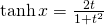
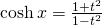
If we have 
From above we get:
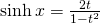
Inverse hyperbolic functions:
Let 
We can write:
 with
with 
But we know:

We plugin:

Taking the  of both sides:

Let 
We can write:
 with
with
But we know:

We plugin:

Taking the of both sides:

Problem 1:
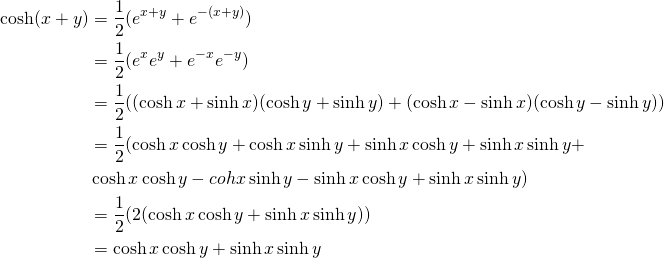
Prove the sum formula below:
Solution
To solve this problem we use the following formulas:







The same way we can prove that

Back to the formula
(1) 

Be the first to comment