
Implicit differentiation
Sometimes we are presented with equations in two variables,  and
and  that may have multiple solutions for in terms of or for in terms of .
The solutions found will be implicitly defined by the given equation.
For parametric functions, we use the following rule:

Problem 1
Given:

Find  or
or 
Solution:
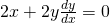


Finally :

We know that the given equation is a circle.
is simply the slope of the tangent of the circle at any point of coordinates 
Problem 2:
Given:

Find or
Solution:





Finally :
Problem 3:
A sphere has a radius  at time
  . What will be the value of that radius when the rate of increase of the volume
  is twice the rate of increase of the radius .
Find the corresponding value of the Volume .
Solution
The volume of a sphere is given by the formula:

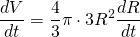
But: At the time when the rate of increase of is twice the one of , we can write:


We get:
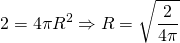

The volume
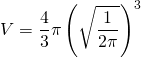
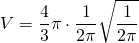

Finally:

Problem 4:
Find the equation of the tangent and the normal to the curve:
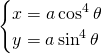
At the point 
Solution
We can find the



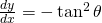
At point :

This is the slope of the tangent. It is clear that the slope of the normal is 1.


For the tangent, we know that:





Equation of the tangent:

For the nomal we use the same method but different slope:




Equation of the normal:
Problem 5:
Water is being poured, at a rate of  into a leaking cylindrical cone shaped container with the top having 8 feet as diameter and which is 16 feet deep.
When the water is 12 feet deep, it was measured to be rising at a rate of  .
.
How fast is the water leaking?
Solution
The ratio of cone height over radius is : . The diameter is 8 feet.
We can then write:

Where  is the height and
  is the radius.
Let  be the rate of volume change at time
  .
.
 be the leaking rate at time .
 be the filling rate at time . It is 10 ft^{3}/min at any given time.
 is the rate of change of the height at any time

The volume of the cone:

But:


Taking the derivative of v with as variable:

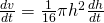
 ft/min and
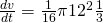

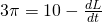
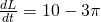
Finally:
The leaking rate is 
Problem 6:
Find the minimum distance from the point  to the parabola
What is the equation of the tangent of the parabola at the point of the minimum distance to
Solution

For each point we use the following coordinates:

The distance from any point:




The Distance:



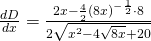

We can see that the equation of the distance opens up. So the first derivative test is a minimum.
We just need the numerator to be 


Let’s square both sides:


When we can see that 
Back to the distance to plug in and values:

For the tangent:



For our point 
The slope of the tangent is 

The equation:




Finally

The tangent

Be the first to comment