
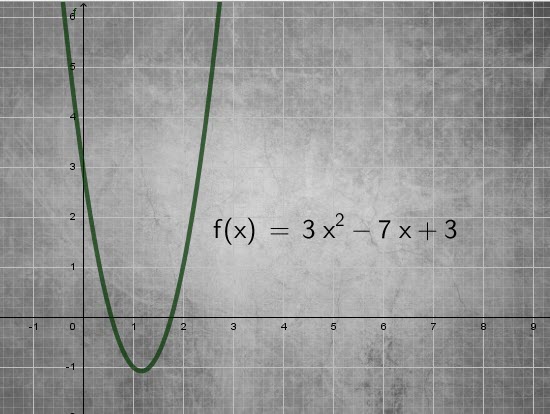
Quadratic Equations
Quadratic Equations
A quadratic equation is written in the following form:
These equations contain polynomials of the second degree, with the square being the highest exponent.
It is important that we find the values of the constants  ,
,  and
and  . The standard form must be written in the above format.
The exponent of 2 must be present in order for it to be a quadratic equation. When the equation is given in another form, we can always re-arrange it to get 
Example:  We need to put this in the standard form:


Now multiply all by  to get the standard form:
Please note that and can be  ,
,  or
or  .
.
1.Solving by Factoring:
We have used factoring in our examples in this site. Now we can see how we arrived at these factors.
Given :
Solve by factoring.
(1) ![\begin{equation*} \begin{split} ax^2+bx+c&=a(x^2+\frac{b}{a}x+\frac{c}{a})\\ &=a\left[{(x+\frac{b}{2a})}^2-{(\frac{b}{2a})}^2+\frac{c}{a}\right]\\ &=a\left[{(x+\frac{b}{2a})}^2-\frac{b^2}{4a^2}+\frac{4ac}{4a^2}\right]\\ &=a\left[{(x+\frac{b}{2a})}^2-\frac{(b^2-4ac)}{4a^2}\right]\\ &=a\left[{(x+\frac{b}{2a})}^2-{(\frac{\sqrt{b^2-4ac}}{2a})}^2\right] \end{split} \end{equation*}](https://www.mouctar.org/wp-content/ql-cache/quicklatex.com-01a28772e3a1b8a8e12a97c63a084779_l3.png "Rendered by QuickLaTeX.com")
Now we have the difference of squares seen in the identities lesson:
(2) ![\begin{equation*} \begin{split} a\left[{\left(x+\frac{b}{2a}\right)}^2-{\left(\frac{\sqrt{b^2-4ac}}{2a}\right)}^2\right]&=a\left[\left(x+\frac{b}{2a}+\frac{\sqrt{b^2-4ac}}{2a}\right)\left(x+\frac{b}{2a}-\frac{\sqrt{b^2-4ac}}{2a}\right)\right]\\ &=a\left[\left(x+\frac{b+\sqrt{b^2-4ac}}{2a}\right)\left(x+\frac{b-\sqrt{b^2-4ac}}{2a}\right)\right] \end{split} \end{equation*}](https://www.mouctar.org/wp-content/ql-cache/quicklatex.com-1276b788e0c70a4b5fcbf74dd0adee81_l3.png "Rendered by QuickLaTeX.com")
Going back to our equation:
![ax^2+bx+c=a\left[\left(x+\frac{b+\sqrt{b^2-4ac}}{2a}\right)\left(x+\frac{b-\sqrt{b^2-4ac}}{2a}\right)\right]](https://www.mouctar.org/wp-content/ql-cache/quicklatex.com-721702bb112800e404887643dc812963_l3.png "Rendered by QuickLaTeX.com")
Finally we get:
From 

Any of the two factors will define one solution.
The two values of  are:
are:


Solved by factoring.
2. Further Factoring methods
It may so happen that the roots are simple integers easy to find. We use the following method for factoring.
If we have  We can try to find two values such:
-Their sum is -Their product is  Then we rewrite our expression by replacing by these two numbers. Example:
Factor:

Here


Find 2 numbers with a sum of  and a product of
  .
.
With experience, we see that  and
and  are the two numbers.
Now we write:
(3) ![\begin{equation*} \begin{split} 5x^2-21x-20&=5x^2-25x+4x-20\\&=(5x^2-25x)+(4x-20)\\ &=\left[5x(x-5)+4(x-5)\right]\\&=(x-5)(5x+4) \end{split} \end{equation*}](https://www.mouctar.org/wp-content/ql-cache/quicklatex.com-be6051a12f0aa2123598c31323e425a7_l3.png "Rendered by QuickLaTeX.com")
Finally: 
3- Using the quadratic formula
To solve , we are not going to factor every time. We use the formula we discovered earlier.
let’s use a discriminant  such:
such: 
From part 1 we get the following case:
-When  we have two roots for solution

-When  we have a duplicate root for solution

–When  there is no root in the real number system
(Since we do not have a square root for a negative number).
4. Completing the square:
We have nearly used it in part 1. We have to isolate the  by moving everything else to the right side.
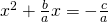
But we know from identities that:

So we simply get: 
Then



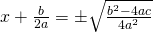
Finally, the solution with the two possible roots:
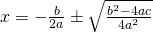
Example:Solve by completing the square:







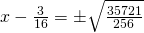


Answer: 
Relationships between the roots of a quadratic equation
When the equation has two roots  and
and  in
in  , we can note the following:
Sum of the roots
(4) 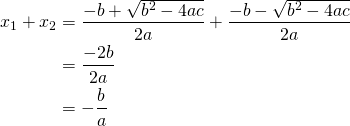
Finally:
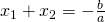
The product of the roots
(5) 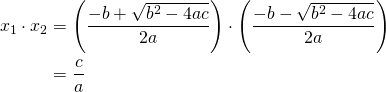
Finally:

Solve for

Please note that 
let 
We get:

Here:


(6) 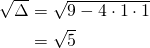

Since we plug in:


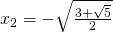

Since we plug in:


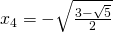

Solve for :

We proceed by grouping:



Two cases:

This is the only solution:
Answer: 
Solve for

Let 
We get:



(7) 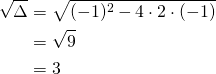

But 


But 

Answer: 
Solve for

But when we can factor: 
The Equation becomes:  with
with 
By using the common denominator: 



The roots:
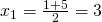
Not acceptable

Answer: 
Solve for

Squaring both sides 

Squaring one more time 


Verification shows  on each side.
Answer: 
Quadratic functions
A quadratic function has the form

As we have already seen, a,b and c are real numbers with 
The domain of the quadratic function is the set of all real numbers.  is defined for any value of .

Or simple:
 .
.
In the previous paragraphs, we solved the quadratic for . We can use the same concept here in graphing the quadratic functions.
x-intercepts:
These are the solutions found by solving  . We’ll see that this statement is the
  . The value of
  is anywhere in this axis.
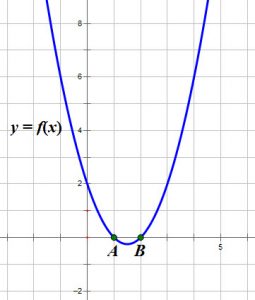
So we have 3 possibilities:
When  is , we had two values as roots. In graphing, the function crosses the at these 2 points.

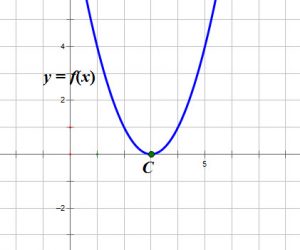
When is  , the function touches the at that point.
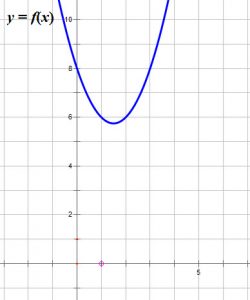
When is , the function never crosses or touches the .
The  is where the function crosses the
  .
.

We can get it by making the variable equal to .
We need to re-write these functions in the following format
(8) ![\begin{equation*} \begin{split} (ax^2+bx+c)&=\left[a \left(x+\frac{b}{2a}\right)^2-\left(\frac{b}{2a}\right)^2+\frac{c}{a}\right]\\ &=a\left(x+\frac{b}{2a}\right)^2+\frac{4ac-b^2}{4a} \end{split} \end{equation*}](https://www.mouctar.org/wp-content/ql-cache/quicklatex.com-109723f9d837bf7ff13341a1a17019de_l3.png "Rendered by QuickLaTeX.com")
Let 
And

The function can be written:

In graphing we’ll see that the point  is the vertex of the function.
This is the point that defines the axis of symmetry.
is a vertical line that is the axis of symmetry of the function.
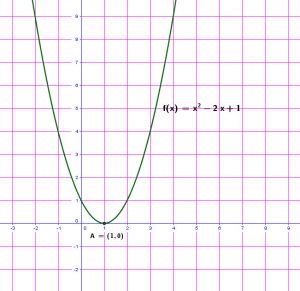
Example
Graph 


And 

We re-write:

The vertex is 
y-intercept: When  ,
, 
x-intercept:
The solutions:
It touches the at the vertex.

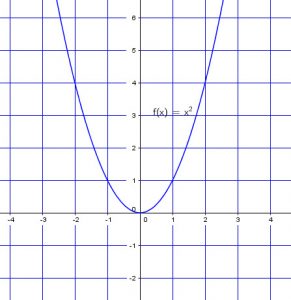
Graphs variations
If we are using the form  , we need to know how to graph these functions without long logics.
Let’s go from the base:


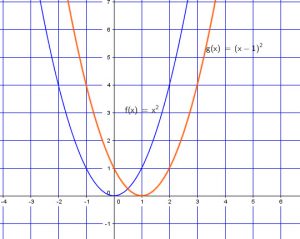
Now for , we just have to move this original graph 1 unit to the right.

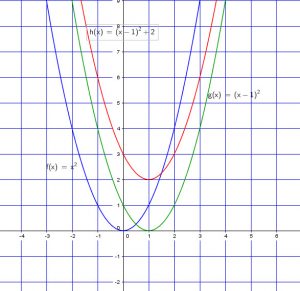
Now let’s add to the y-coordinate
 , we just move the graph two units up.

Now if we change the sign of
 . The function is flipped about the . It is the mirror of the original.

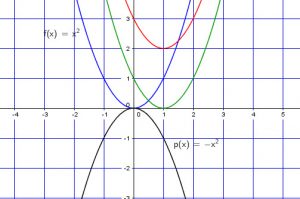
Now let’s make from the original


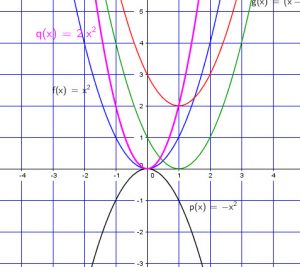
We can now say:
-If we flip the original before moving
-If  , we move the original to the right by
  units.
-If  , we move the original to the left by units.
-If  , we move the original up by
  units.
-If  , we move the original down by units.
-If  the graph is narrower
-If  the graph is wider.
Example:

From ,
flip, move 3 units to the left, move 2 units down. Graph is wider.

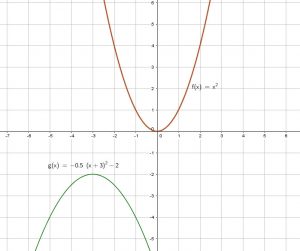
Grph the function:


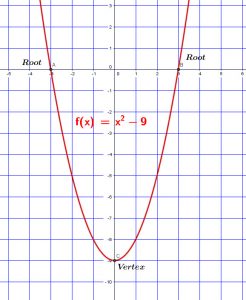
Problem 1
A certain equation has been graphed as follows. Please find the equation in the form of

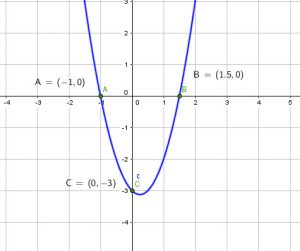
Solution:
Click on the following to watch the video for the solution
Problem 2:
Given the following equation:

1. What values of  make this equation, an equation with 2 roots?
2. Find the values of so that the equation has only one root as a solution. Calculate the root in each case.
3. Find all the values of making the equation one without a solution in .
4. Find the values of that give a solution of 4 as one of the roots.
5.Finally, find the values of making the product of the two roots  .
.
Solution:
Click here for the Solution in another post.
Problem 3:
Given the following equation:
1. Find the positive value of so that the equation has only one root as a solution.
2.Calculate the root.
Solution:

For a double solution, the discriminant must be



This is the only value per the prompt.
For we get:




Be the first to comment