

Sequences and series
This is a quick summary of sequences and series for a refresh purpose only.
We will explore various situations so we can get up and running in problems involving series.
When we wake up in the morning, if we write down on a hourly basis all events happening during the day, we end up having a sequence of these events.
In a sequence we will enumerate 1,2,3,4, …..
We can even graph the sequence as it is a function.
We can summarize:
A sequence can be defined as a function having a domain in the set of positive numbers.
In the following sequence:
 ,
,  ,
, ,
, ,….
,….
We can see numbers in an ordered list. We call them  of our sequence.
Taking  and giving
  values 1,2,3,4,….. We get the sequence shown above.


……………………..
The formula for the  term as above in is called the
  of the sequence.
The factoral notation:
if  is an integer, the factorial notation
  is:
is:


 for
for 
Please note that:

Examples


Recursive formula:
We may be presented a situation where we have to find the next value based on previous value and a rule given to us. This rule is called the recursive formula.
Example:


We have to know the previous term in order to find the next term.
In this example:



See the picture?
Fibonacci Sequence:



We get the following:

Summation or Sigma notation:
We cannot discuss sequences without using the powerful sigma notation:
The following sequence:

Can be written using the sigma notation.
If  is a variable going from
  to , we can say that this is the sum of
  when goes from to
We can write:
![\[x_{1}+x_{2}+x_{3}+x_{4}+x_{5}+\cdots+x_{n}=\sum_{k=1}^{n}x_{k}\]](https://www.mouctar.org/wp-content/ql-cache/quicklatex.com-e4ac71a5989b75fc6af899b4fc42bcbb_l3.png "Rendered by QuickLaTeX.com")
Example:
![\[\sum_{k=1}^{n}x_{k}^{2}=1^{2}+1^{2}+2^{2}+3^{2}+4^{2}+\cdots+n^{2}\]](https://www.mouctar.org/wp-content/ql-cache/quicklatex.com-6ebf79ea9e036b4c767e1a100f10bd8f_l3.png "Rendered by QuickLaTeX.com")
In these formulas, is the  .
.
Properties of Sequences:
If  and
and  are seuqences and
  is a real number, we have the following THEOREM:
![\[\sum_{k=1}^{n}(ca_{k})=ca_{1}+ca_{2}+ca_{3}+ca_{4}+\cdots+ca_{n}=c\sum_{k=1}^{n}a_{k}\]](https://www.mouctar.org/wp-content/ql-cache/quicklatex.com-de1c5472be846ced23e88609a504d009_l3.png "Rendered by QuickLaTeX.com")
![\[\sum_{k=1}^{n}(a_{k}+b_{k})=\sum_{k=1}^{n}a_{k}+\sum_{k=1}^{n}b_{k}\]](https://www.mouctar.org/wp-content/ql-cache/quicklatex.com-1be4da6be0ceb5741d42309c0b588988_l3.png "Rendered by QuickLaTeX.com")
![\[\sum_{k=1}^{n}(a_{k}-b_{k})=\sum_{k=1}^{n}a_{k}-\sum_{k=1}^{n}b_{k}\]](https://www.mouctar.org/wp-content/ql-cache/quicklatex.com-169f05beb9e008f82f5ccb5216a890d9_l3.png "Rendered by QuickLaTeX.com")
![\[\sum_{k=j+1}^{n}a_{k}=\sum_{k=1}^{n}a_{k}-\sum_{k=1}^{j}a_{k}\]](https://www.mouctar.org/wp-content/ql-cache/quicklatex.com-5f86615c28901fb2a705e26fe3a393b1_l3.png "Rendered by QuickLaTeX.com")
where 
Some important sequences and series:
Calculating
![\[\sum_{k=1}^{n}k\]](https://www.mouctar.org/wp-content/ql-cache/quicklatex.com-b9922400c9aeaf3492861aa0e856d334_l3.png "Rendered by QuickLaTeX.com")
We have:


For various values of



……………………………

——————————————————————–

![\[(n+1)^{2}-1=2\sum_{k=1}^{n}k+n\]](https://www.mouctar.org/wp-content/ql-cache/quicklatex.com-e079ee6b2b739aeb7a489c945c0bf95a_l3.png "Rendered by QuickLaTeX.com")
![\[n^{2}+2n+1-1=2\sum_{k=1}^{n}k+n\]](https://www.mouctar.org/wp-content/ql-cache/quicklatex.com-a14eaf4a8973c70aa8ecc7c24ee29e64_l3.png "Rendered by QuickLaTeX.com")
![\[n^{2}+2n=2\sum_{k=1}^{n}k+n\]](https://www.mouctar.org/wp-content/ql-cache/quicklatex.com-12426e87b699718927129dbf9b95de74_l3.png "Rendered by QuickLaTeX.com")
![\[\sum_{k=1}^{n}k=\frac{n^{2}+2n-n}{2}\]](https://www.mouctar.org/wp-content/ql-cache/quicklatex.com-540703189904c2d8d424a61255f21092_l3.png "Rendered by QuickLaTeX.com")
![\[\sum_{k=1}^{n}k=\frac{n^{2}+n}{2}\]](https://www.mouctar.org/wp-content/ql-cache/quicklatex.com-5385797db406856da2027cdc8d584714_l3.png "Rendered by QuickLaTeX.com")
![\[\sum_{k=1}^{n}k=\frac{n(n+1)}{2}\]](https://www.mouctar.org/wp-content/ql-cache/quicklatex.com-9da8517ab9f59bbf6b07d409348a2933_l3.png "Rendered by QuickLaTeX.com")
This is the first relation:
We can prove
![\[\sum_{k=1}^{n}k^{2}=\frac{n(n+1)(2n+1)}{6}\]](https://www.mouctar.org/wp-content/ql-cache/quicklatex.com-18008e1cabbf6dae7aef799fe3e8b041_l3.png "Rendered by QuickLaTeX.com")
Using:

Or, one more exponent:
![\[\sum_{k=1}^{n}k^{3}=\left(\frac{n(n+1)}{2}\right)^{2}\]](https://www.mouctar.org/wp-content/ql-cache/quicklatex.com-6d0ce16a4e699d262ace3234a52203b9_l3.png "Rendered by QuickLaTeX.com")
Arithmetic sequences:
We have already seen that a sequence is a list of numbers in a particular order.
Each number is called a term.In a arthmetic sequence, each term after the first is found by adding a constant value called common difference to the previous term.
The first term is noted 
The common difference is noted  .
.
Looking at the natural numbers:
In this sequence,  and
and  with the common difference
If we develop:




………………………………

We can now see that the term can be noted:When is a positive integer:
EXAMPLE 1:
Given the sequence:
 , find the
  term.
term.
![a_{1}=100<span class="ql-right-eqno"> </span><span class="ql-left-eqno"> </span><img src="https://www.mouctar.org/wp-content/ql-cache/quicklatex.com-a6b1deab9a3f709012df6c34e40776ec_l3.png" height="93" width="584" class="ql-img-displayed-equation quicklatex-auto-format" alt="\[d=96-100=-4$ $a_{n}=a_{1}+(n-1)d$ $a_{7}=100+(7-1)(-4)=100-24=76$ <strong>EXAMPLE 2:</strong> <strong>Given the sequence:</strong> <strong>$5,13,21,\cdots$, find the $nth$ term.</strong> $a_{1}=5\]" title="Rendered by QuickLaTeX.com"/>d=13-5=21-13=8](https://www.mouctar.org/wp-content/ql-cache/quicklatex.com-d9b69575d3befa35a8f9c1b37fe01b80_l3.png "Rendered by QuickLaTeX.com")

Arithmetic means is simply the terms between any non consecutive terms of an arithmetic sequence.
Example:
33 and 35 are two arithmetic means between 31 and 37 in the arithmetic sequence 
Arithmetic series:
Arithmetic series are merely the sum of the terms of an arithmetic sequence.
Arithmetic Sequence: 
Arithmetic Series: 
We have already seen some arithmetic series.
For the first terms of an Arithmetic series:
The sum  is:
is:
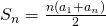
Proof:


————————————

 with and
Given:


Find  and
and 
Solution:
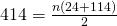


Now for the common difference:




Now we can find any term:


We can actually write the full sequence:

Geometric sequences:
In a geometric sequence, each term after the first is found bu multiplying the previous term by what we call the common ratio  .
.
We note:

The common ratio:

The same way we found the term for the arithmetic sequence, the can find the one for the geometric sequence:
 with any positive integer.
Given:

Suggest an equation for 
Solution:

Equation:

Given:

Find the next two terms
Solution

The next two terms:


Now we have:

Geometric Means
The missing terms between two nonconsecutive terms of a geometric sequence are called geometric means.
Geometric series
Geometric series is the sum of the terms of a geometric sequence.


If we subtract:
 All the rest cancels out.
Finally we can write: For terms: with 
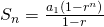
Calculate:
![\[\sum_{n=1}^{6}5\cdot 2^{n-1}\]](https://www.mouctar.org/wp-content/ql-cache/quicklatex.com-42a43ec7bbace1197759a485bdc1af65_l3.png "Rendered by QuickLaTeX.com")
In here the first term is:



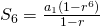
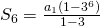
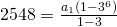
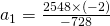
Question:
Find the first term of a geometric series with  and a common ratio of 3.
Solution:


Infinite Geometric Series
Series of the following form are called infinite series:

We can only get partial sums here.
However, when  , when becomes very large we have:

The second term Will be very close to  and has a limit of as approaches
We have the final formula:

With
Given:
![\[Z=\sum_{n=1}^{\infty}24(-\frac{1}{5})^{n-1}\]](https://www.mouctar.org/wp-content/ql-cache/quicklatex.com-60b8ace0db66574e035463d324ce6ec9_l3.png "Rendered by QuickLaTeX.com")
Find  :
:
We can see that:


Finally: 
Please note that some series with alternating signs do not converge.

Be the first to comment