
Higher order Derivatives
In the following formulas, we show the higher order derivatives before diving into practical applications.
If we define functions Like  ,
,  ,
, and
and  with
with  being the variable and
  a natural number:

The chain rule:

This can be used to generate many formulas seen in our table.
Example:

Let 
We know that:


Finally:

Logarithmic Differentiation:
This is a very useful method that can be used to find the derivative of any function.
Using the formula 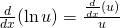
We proceed as follows:



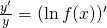


Example:
Find the derivative of:
![y=\sqrt[3]{3x^{2}}](https://www.mouctar.org/wp-content/ql-cache/quicklatex.com-adfee8c2a4f102f86db261b3a657fcb1_l3.png "Rendered by QuickLaTeX.com")
Solution:
![\ln y=\ln (\sqrt[3]{3x^{2}})](https://www.mouctar.org/wp-content/ql-cache/quicklatex.com-72e3dea7c5456163a008d21640fb76c6_l3.png "Rendered by QuickLaTeX.com")

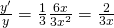
![y'=y\frac{2}{3x}=\frac{2}{3x}\sqrt[3]{3x^{2}}](https://www.mouctar.org/wp-content/ql-cache/quicklatex.com-6061a59c5f21f8e7d6fd0d0320d5cb71_l3.png "Rendered by QuickLaTeX.com")
Second derivative

Higher-order derivatives



Leibnitz’s Formulas











Some Applications of Derivative:
It will not be possible to list all applications of the derivative in few lines. However, through worked problems, this site will help you understand many aspects of the rate of change.
Remember that the derivative is the rate of change of some functions.
When you are driving a car, you start it, you accelerate and your speed increase at a certain rate. After some time, when you stop accelerating, you may drive at a constant speed. When you are near the point of arrival, you slow down and then stop.
The speed has increased, became constant and decreased. This is a typical derivative description. The rate of change was positive, so was the derivative during that period. Then the rate of change became  and finally it became negative to the point of stop.
Mean value theorem:
If a function  is continuous on
 ![[a,b]](https://www.mouctar.org/wp-content/ql-cache/quicklatex.com-9a4afb19d1550c3987a2764cd24dd8f3_l3.png "Rendered by QuickLaTeX.com") and differentiable on
and differentiable on  , then
  for some number
  in .
in .
Corollary :
If  for all in , then is constant on , meaning that there is a constant
  such
such  for all in
Corollary:
Let be a function that is continuous on and differentiable on :
If  for all in , then is an INCRESAING FUNCTION on
If  for all in , then is an DECRESAING FUNCTION on
First derivative Test Theorem:
Let the function be continuous on the open interval and be differentiable there except possibly at
1. If on  and on
  , then
  is the minimum value of on
2. If on and on , then is the maximum value of on
3. If or for all in except for  , then is neither a maximum nor a minimum value for
Tangent line at a given point:

Normal line at a given point:

Inflection Points
If  exists and
  changes sign at
  , the the point
  is an inflection point of the graph of . If
  exists at the inflection point, then
L’Hopital’s Rule
![\[\lim_{x \to c}\frac{f(x)}{g(x)}=\lim_{x \to c}\frac{f'(x)}{g'(x)}\]](https://www.mouctar.org/wp-content/ql-cache/quicklatex.com-c0db7d28c8508819d145ccdc6d482387_l3.png "Rendered by QuickLaTeX.com")
if:
![\[\lim_{x \to c} f(x)=\lim_{x \to c} g(x)=\begin{cases}0\\ \infty \end{cases}\]](https://www.mouctar.org/wp-content/ql-cache/quicklatex.com-7e3a6890d9925d7c76044267e151d99c_l3.png "Rendered by QuickLaTeX.com")

Be the first to comment