
Exercise:


Find  ,
, ,
, and
and 
Solution:
We notice that 




Finally:

Evaluate:

Solution
Let 
We try to find the polar expression:
The modulus:

Now for the argument:
if  ,
,
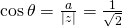
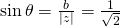
We can see that 
Now we can write:

Or even better:

Now the fabulous De Moivre formula
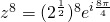
 But remember:
So we get 




Finally:
Answer: 
Problem:
Find the 8th roots of 
Solution:
, finding the 8 roots
Let 

Modulus:


We can write in polar form:


 here from
  to
to 
The roots:








Finally:
Answer:
Solve for 

Solution




Our challenge is to find another complex number, the 
Let 
The modulus:

Now:

Base angle:

From our unit circle, the with both sine and cosine <0 is base angle plus 180 degrees.

However, our notation  makes it
Now:






Finally:
Answer: 
Problem:
Solve for

Solution
Let 
Modulus:
 Please note that
Now the arg(w)

From the unit circle:
The base angle here is 
Now a combination of the trigonometric functions give 
We need to find 3 roots with 
The notation becomes:

Now:

The roots:



Some future formulas:




For  we use the transformation formulas and we get:


Problem:
Evaluate 
Solution
This can be done 2 ways
The peasant way,
Use binomial and note that this can be lengthy if the exponent is high

The poet way:
Use complex numbers operations. Always try this way.
Modulus:

The base angle: and is also the 



Finally:
Answer: 
Problem:
Evaluate 
Solution

The second method, more efficient for multiple comple numbers.


Base angle

With the  showing
  , we are in the first quadrant of the unit circle.
So, 


Base angle

With the showing  , we are in the fourth quadrant of the unit circle.
So, 
The product:


Answer: 
Problem:
Evaluate 
Solution
Two methods:
The first method

The second method, more efficient for multiple complex numbers.
Base angle
With the showing , we are in the first quadrant of the unit circle.
So,
Base angle
With the showing , we are in the fourth quadrant of the unit circle.
So,


Answer: 
Problem:
Evaluate 
Solution
For the conjugate we know:

Let 
The values of the angle are exposed
We know that the modulus 

That means:
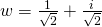
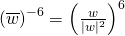
This brings home:
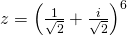
Regular calculation:
Modulus and base angle:  since we are in first quadrant.
 But remember
That means:

Finally
Answer: 
Exercise 27C (From EARL):
Let 
Show that  and deduce that
Find the quadratic equation with the roots  and
and  .
.
Hence show that 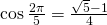
Our Approach and solution:
In the polar coordinates:


We know that:

This means:

To get 5 roots reals and complex, both factors must be equal to
We get:

To find the roots of the quadratic, let’s evaluate each element:
With in mind the argument



The roots are:
and
The product:


This means we can change the following:
to:


When we convert:


Let 



Before we go further, please note that  since our angle is the first quadrant.

Finally:
Answer:
Exercise 28C (EARL)
Determine the modulus and argument of the following complex numbers:
 and
and  .
.
Calculate  using polar coordinates and
  form.
form.
Deduce the  and
and  .
.
Our Solution:

modulus:




modulus:

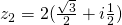


Now Calculating
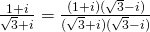

In polar form:



Now we can say:





Finally
Answer: 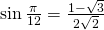 and
and 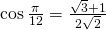
Exercise 30 B (EARL):
Using the 7th roots of -1 show that:

Use a similar process to evaluate:

Solution:

Modulus:
Argument:
 and
and 
This means 

The 7th roots:
 with
with 








Sum of roots is

This yields:

The same way, if we let:
 we get the following:

Finally:
Solve for

[accordion hideSpeed=”300″ showSpeed=”400″]
[item title=”Click here to see the solution of: “]
Solution:


Finally:
Answer: 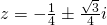
[/item] [/accordion]
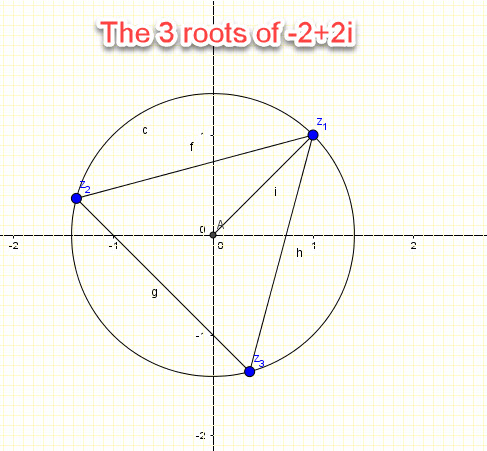
Solve 
Draw the roots and calculate the area of the triangle formed by the three roots.
Solution:
Modulus:









Finally:
Answers: 
Write in form:

Solution:

Please note  is 1 radian or
  in degrees.
So:

Finally:
Answer: 

Be the first to comment