

Areas of circles and triangles
Perimeter of a triangle:
The perimeter of a triangle is the sum of its 3 sides.
In the following figure we have:
 is the
  of the triangle.
We have used the semi-perimeter of the triangle when we deomnstrated the Heron formula.
It is simply 
The student learns to calculate perimeters to be able to tackle problems involving costs of fences for example.

Example:
A location has a form of a triangle. The three sides have measurements of 250ft, 185ft and 215 ft. A fence costing 7 dollars per linear foot has to be constructed around the location, leaving an entry of 5 ft. The company hired for the construction charges 6 dollars for each linear foot. What will be the total cost of the fence?
Solution:
The perimeter of the triangle:

However, the entry of 5 ft will not get the fence.
We get:

Total cost per foot:

Total cost for constructing the fence:
 dollars.
Area of a triangle:
The area of a triangle can be calculated using methods depending on information we have:
For a scalene triangle:
-Taking any altitude (as height, h) and its opposite side (as base, b).
The Area is:

We can also write:


For an isosceles triangle, given the three sides: a,a and b
We can calculate 
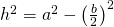
Finally:

And the area of the triangle:

If we use the Heron formula, we find the same formula

In our situation  and
and 
That means 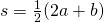



We get the following area:

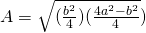
Finally:

Special isosceles and right triangle:
In this situation we have :

Without going far, we can notice that each of the right triangle legs can be the base (a) or the height (a):


Using b:


This can be found from the previous formula as well.
Equilateral Triangle
We have the nomrmal formula:




Now for the area we have
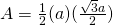

finally:

Area Triangle using angles:
We can see that:


So: 
The Area:

We can find all three relationships:


Circumference of a circle
The Circumference  of a circle is as follows:

where  is the radius of the circle.
Since the diameter  , we can write:


Areas and circumferences of circular figures can be calculated without replacing  with its value. That means in terms of .
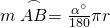
Length of an arc:

The length of an arc of a circle is related to the central angle  that intercepts it.
If is in  , we have:

For an angle in  , we use the proportion to the circumference:
The length of 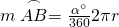
This is the same as:
Area of a Circle of radius r:

If is the radius of a circle, the  is:
is:

This formula is widely used in geometry and other fields.
Area of a Sector AOB of a circle:

If is the radius of a circle, the central angle (or intercepted arc) in , the of  is:
is:

We simplify and get:

If the central angle (or intercepted arc) is in :

This is a simple conversion of radians above. 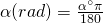
Area of a segment of a circle

This can be approached 2 ways:
-Area of the sector minus area of isosceles triangle 
-By deriving the formula.
The central angle’s bisector bisects the chord AB at D.
We get

But 

OD is the altitude:



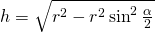
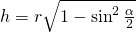
But we know that:

That returns:

The Area of  is:
is:

We plug in:

Finally:

For sector AOB:

We take the difference to get the area of the segment:



Be the first to comment