
2.Integration by parts
This is the technique of transforming one integral into another that is easier to evaluate.
The integration by parts comes from the following derivatives formula:

This can be written:

Taking the indefinite integral of both side we get:

Or simply:
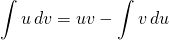
We must make an adequate choice in order not to get a more complicated integrated.
One of the favorite examples is:
Evaluate 
Let 


Problem 13
Evaluate: 
Let 

We get:
(1) 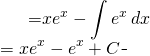
Finally:

Problem 14
Evaluate: 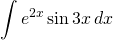
Let 

We write:
(2) 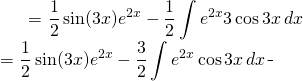
We resume the process for the second part of the integral:
Let 
(3) ![\begin{equation*} \begin{split} \displaystyle \int e^{2x} \sin 3x\, dx}&={\displaystyle \frac{1}{2} \sin (3x) e^{2x}-\frac{3}{2}[\frac{1}{2} \cos (3x) e^{2x}+\frac{3}{2}\int e^{2x} \sin 3x\, dx]}\\ &= {\displaystyle \frac{1}{2} \sin (3x) e^{2x}-\frac{3}{4}\cos (3x) e^{2x}-\frac{9}{4}\int e^{2x} \sin 3x\, dx \end{split} \end{equation*}](https://www.mouctar.org/wp-content/ql-cache/quicklatex.com-13a3be41feca8ab983f8c3a34c8774a5_l3.png "Rendered by QuickLaTeX.com")
We are back to a fraction of the original:




Finally:
Problem 15
Evaluate: 
Let 
We write:
(4) 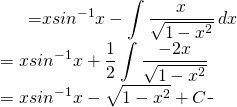
Finally:

Problem 16
Evaluate: 
Let 

We write:

We resume:
Let

Back to the original equation:
![{\displaystyle \int e^{x} \cos x\, dx}={\displaystyle e^{x} \sin x -[-e^{x} \cos x + \int e^{x} \cos x\, dx]}](https://www.mouctar.org/wp-content/ql-cache/quicklatex.com-f369e32d28a390f24659911ef3957247_l3.png "Rendered by QuickLaTeX.com")



Finally:
Problem 17- Special Case
Evaluate: 
When  is a large natural number,we decrease by
  to case a situation where we have to integrate
We proceed as follows:
Let 

We get:

Or:


We find the original integral in the right part. We group and we get:


We get:

This is very useful when combined with our know formula:

Problem 18
Evaluate: 
Let 
Or:

We get:

Now, just for fun

Let 







Back to the original equation:


Finally:

Be the first to comment