
Introduction to Conic Sections
Conic sections can be generated when one slanted line revolves around an intersecting a vertical line . We get two cones joined at the intersection and expading indefinitely upward and downward.
When a plane intersects the created double cone, we have a conic section at the intersection.
Depending on how the plane is intersecting the conic section, we get different types of conic sections.
The conic sections may be : parabola, ellipse, hyperbola, circle etc…
The following is a summary to enable us to solve problems involving the conic sections.
The Parabola:
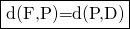
A parabola can be defined as the collection of all points  in the plane that are the same distance
  from a fixed point
  as they are from another fixed line
  .
.
The point is called the 
The line is the  .
.
The line through the focus and perpendicular to the directrix is the  .
.
The point of intersection of the parabola and its axis of symmetry is the  , noted
  .
.
If we take a VERTEX at  , with FOCUS at
  while
while  , by definition the DIRECTRIX will be the line
  .
.
Using the definition above and the distance formula:

Solving we get:
Equation of the parabola:

The LATUS RECTUM here has a length of  and is defined as the line segment joining
  and
and 
We get the following cases: for a VERTEX at (h,k):
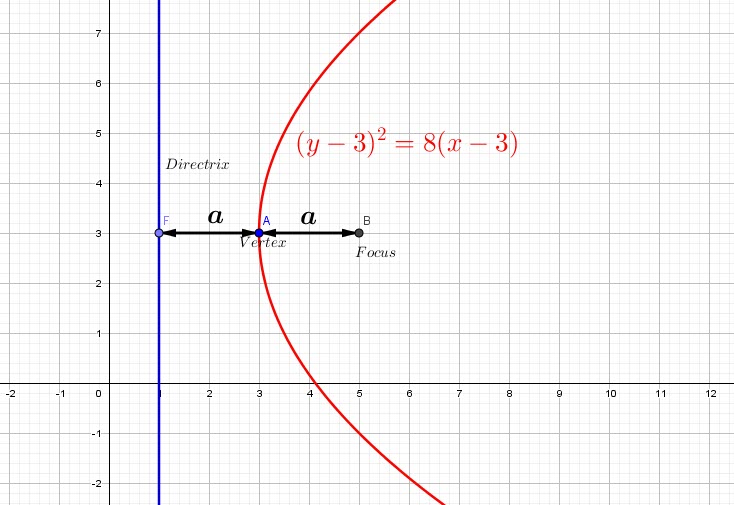
-When for vertex  we have a focus
  , the DIRECTRIX will be the line
  and the equation is
  Symmetry axis is parrallel to
  , opens right.
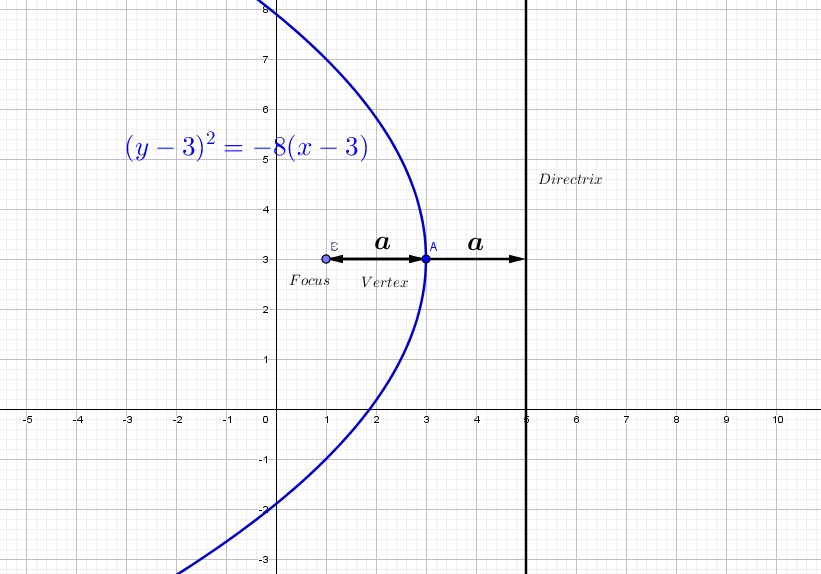
-When for vertex we have a focus  , the DIRECTRIX will be the line
  and the equation is
  Symmetry axis is parrallel to , opens left.
-When for vertex we have a focus  , the DIRECTRIX will be the line
  and the equation is
  Symmetry axis is parrallel to
  , opens up.
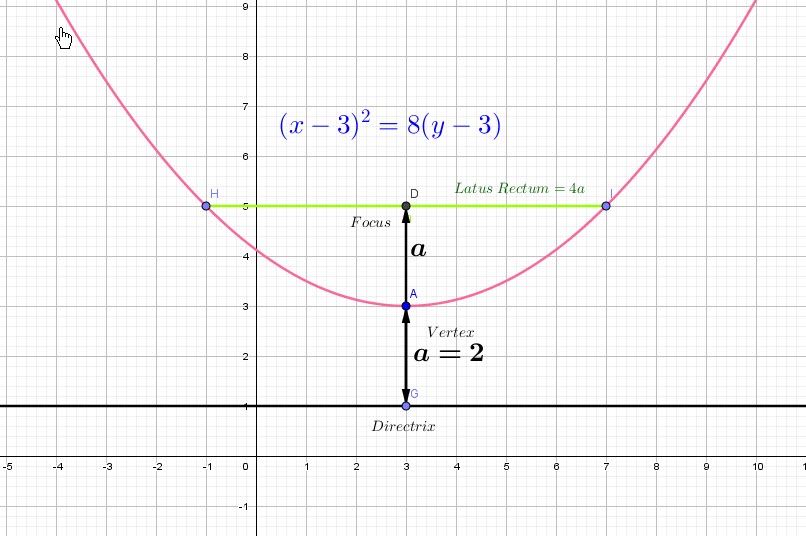
-When for vertex we have a focus  , the DIRECTRIX will be the line
  and the equation is
  Symmetry axis is parrallel to , opens down.
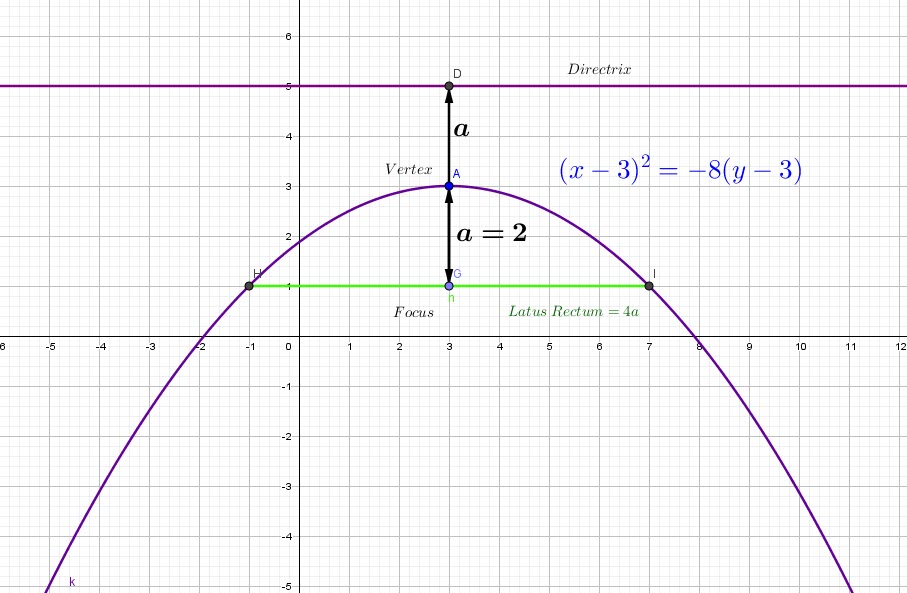
We get the following cases: for a VERTEX at (0,0):
-When for vertex  we have a focus , the DIRECTRIX will be the line and the equation is Symmetry axis is , opens right.
-When for vertex we have a focus  , the DIRECTRIX will be the line
  and the equation is
  Symmetry axis is , opens left.
-When for vertex we have a focus  , the DIRECTRIX will be the line
  and the equation is
  Symmetry axis is , opens up.
-When for vertex we have a focus  , the DIRECTRIX will be the line
  and the equation is
  Symmetry axis is , opens down.
The Hyperbola:
A hyperbola can be defined as the collection of all points in the plane, haveing a difference of distances from two points,  as constant.
The line containing the Foci is the  .
.
The  of the hyperbola is the midpoint of the segment joining the .
The perpendicular of the transverse axis trhough the center is called the  .
.
The two separate curves of the hyperbola are the 
The points of intersection of the hyperbola and the transverse axis are the  of the hyperbola.
If  ,
,  with
with  the distance between a focus and the center.
For any given point  , we can have:

Using the distance formula:
In this equation we have 


Let’s square both sides:

We simplify:

Simplifying by 4


Let’s square both sides again:





Let: 
We get:

Now dividing both sides by 
We have the hyperbola formula:

The transverse axis here is the
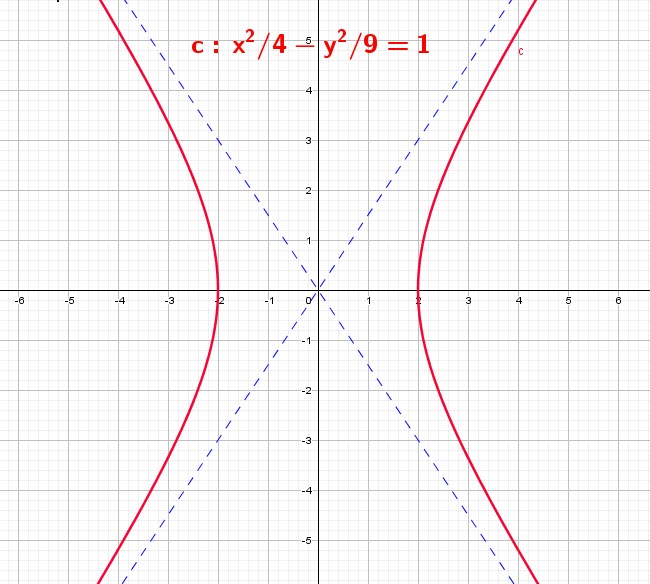
Asymptotes:
We’ll see in future chapters how to calculate the limits.
However, if we take:
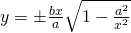
When  approaches infinity (left or right side), the value
  approaches
we get:
 and
and
These are the two oblique asymptotes:
 and
and
For the hyperbola of Center at ; The transverse Axis along the 
Foci are at  and
and  ,
,
and vertices at and

Asymptotes:
We’ll see in future chapters how to calculate the limits.
However, if we take:

When approaches infinity (left or right side), the value  approaches
we get:
 and
and
These are the two oblique asymptotes:

and
Hyperbola Equations:
Transverse parallel to the
Center
Foci: 
Vertices:
Equation:

Asymptotes:

Transverse parallel to the
Center
Foci: 
Vertices:
Equation:

Asymptotes:

The ELLIPSE:
The Ellipse can be defined as the collection of all points in the plane, having a sum of distances from two points, as constant.
The line containing the Foci is the  .
.
The of the ellipse is the midpoint of the segment joining the .
The perpendicular of the major axis trhough the center is called the  .
.
The points of intersection of the ellipse and themajor axis are the of the ellipse.
If  and
and  ,
,  is the constant distance: Point

Using the same technic we used for the Hyperbola:

 where
where 
The major axis here is along the
For the Ellipse of Center at ; The major Axis along the
Foci are at and ,
and vertices at and
where
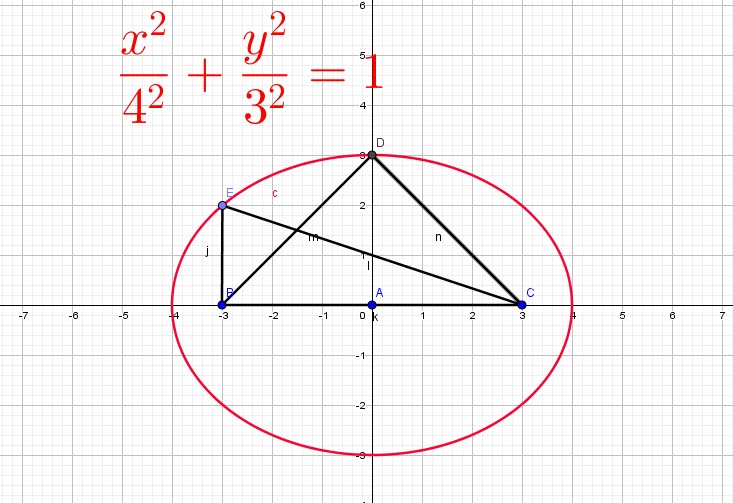
Ellipse Equations:
Major axis parallel to the
Center
Foci:
Vertices: 
Equation:

Major axis parallel to the
Center
Foci:
Vertices: 
Equation:

The Circles
A circle is the set of all points in a plane that are equidistant from a given point in the plane, 
The distance from any point to the center is  .
.
For a circle of center .
For a point 
The radius  can be found using the distance formula;

We square both sides:

The Equation of the circle of center
The tangent is perpendicular to the radius at the tangency point.
For more details see our course on CIRCLE ESSENTIALS.
Conics, general equation
Conics can be identified using the general equation when we do not have a degenerating case:

 and
and  cannot both equal
When  , we have a PARABOLA
When  we have an ELLIPSE (or CIRCLE)
When  , it is a hyperbola
We can also use the following rule to identify a conic:
When we do not have a degenerating case:

When  , we have a PARABOLA
When  we have an ELLIPSE (or CIRCLE)
When  , it is a hyperbola
Conics in polar Equations
In this passage, we are going to express the conics dicussed above, using their polar notations.
For a given Conic, we will call the line the  , a given .
In our new notation, let’s introduce  as a fixed positive number, the
  .
.
A  is then the set of points
  such the ratio of the distance
  to the distance
  is .
is .

– For the parabola, we can note that 
-For the ellipse we have 
-For the hyperbola 
If is the distance from the center to the focus and  is the distance from the center to the vertex, for ellipse and hyperbola:

Each point can be expressed in polar coordinates as 

If we drop a perpendicular from to the polar axis with  as intersection, we can write:

But we can see that 
We can plug in:


Solving for we get:
The polar equation of a Conic:

With the eccentricity of the conic.
If the is perpendicular to the polar-axis at a distance  on the right of the pole:
we get:

SUMMARY
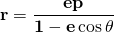
1. Directrix perpendicular to the polar axis at units to the left of the pole:
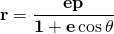
2. Directrix perpendicular to the polar axis at units to the right of the pole:
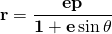
3. Directrix parallel to the polar axis at units above the pole:
4. Directrix parallel to the polar axis at units below the pole:
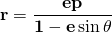
Please note:
-For , the conic is a parabola, the axis of symmetry is perpendicular to the
-For , the conic is an ellipse. The major axis is perpendicular to the
-For , the conic is a hyperbola. The transverse axis is perpendicular to the
Converting from polar to rectangular and vice-versa
We use the following relationships:


And of course:


Be the first to comment